
Contributors
Your Clothes Aren’t Wearing Out, They’re Being Washed Out
Why do clothes fade, pill and lose their shape? Filthy Clean co-founder Bree Uebergang breaks down how your laundry habits are doing the damage.
Your washing machine and laundry detergent will do more damage to a jumper than you ever will. The fading, the stiffness, the shape that never came back, most of that happens in the wash rather than on your back.
I know that because I read detergent specifications for a living. My husband and I run Filthy Clean, an Australian laundry sheet brand, so ingredient lists and dosing tables are the day job.
We talk a lot about buying better and buying less. Both matter enormously. But between the shop and the bin there are two or three hundred wash cycles, and that is where most clothes are lost.
Start with the machine, not the garment
If you want a garment to last, the most powerful thing you own is your washing machine, and the way you use it.
I find that cheering, because it is the one part of the fashion system a normal person controls completely. You cannot fix a supply chain from your laundry. You can absolutely stop shredding your own jumpers.
The far end of that pipeline is where clothes go to die, and the numbers there are grim. This is the upstream end of the same problem.
Four things changed how long my clothes last. Here they are in the order they made a difference.
1. You are using far too much detergent
This is the one almost nobody gets right, and it is the easiest to fix.
More detergent does not mean cleaner clothes. Past a certain point it means the opposite. Your machine is dosed to rinse away a set amount of surfactant, and anything beyond that stays behind, in the fibres, as a fine residue.
That residue attracts dirt. It stiffens fabric. On dark colours it reads as fading, because you are looking at a dull film sitting on top of the dye rather than dye that has gone anywhere.
The bobbling people blame on cheap cotton is often residue plus friction, doing its work over a year.
Almost everyone I talk to is overdosing, and nearly always because the cap or scoop is bigger than the dose. Caps are not measuring devices. They are packaging.
If you want the full version, including how much you actually need for a normal load, I wrote about how much laundry detergent you actually need in more detail.
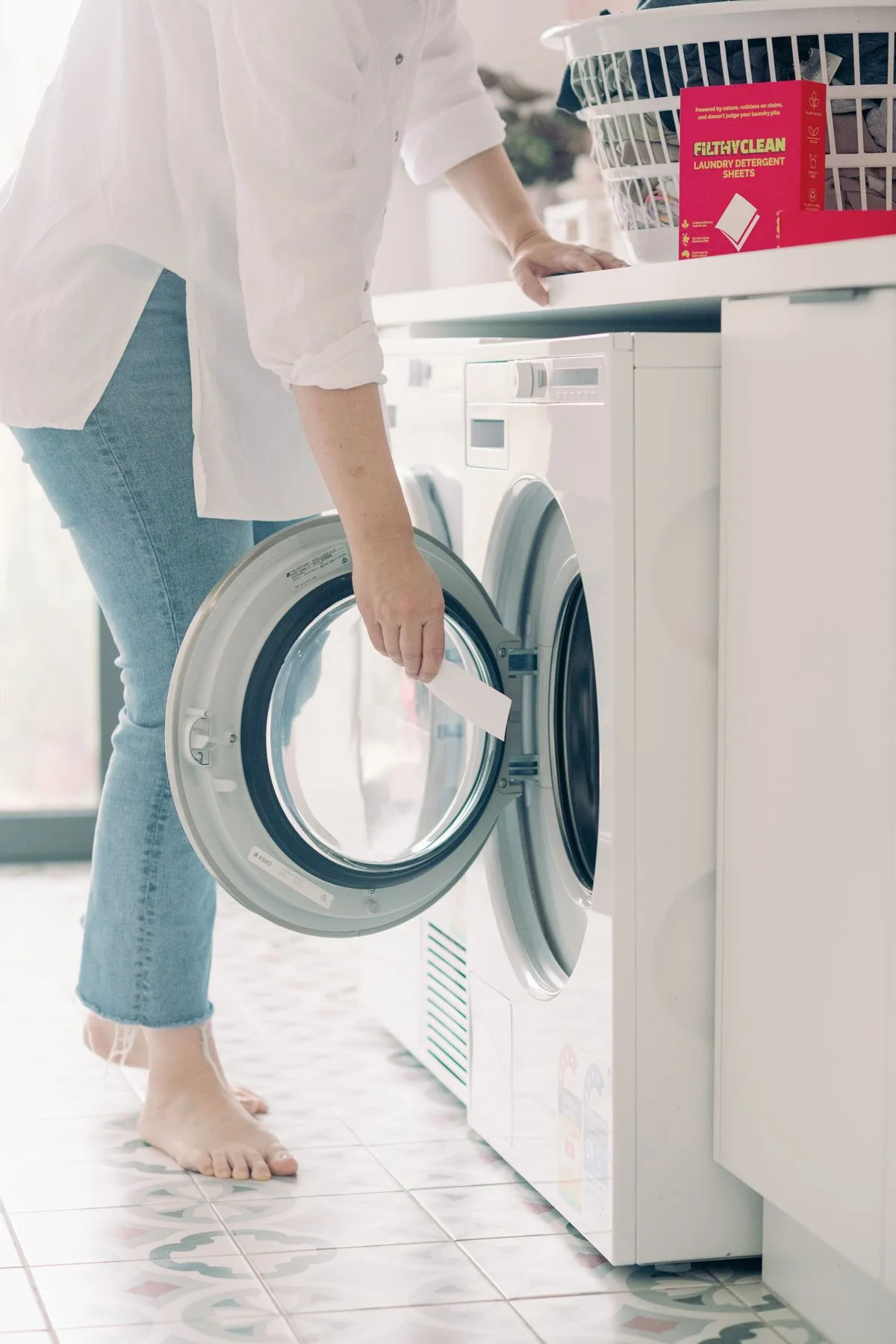
This is most of why I ended up making laundry sheets instead of another bottle. A sheet is one dose, so the decision is gone. You can still get plenty wrong in a laundry, but you cannot accidentally tip in three times what the load needed.
The packaging is plastic-free cardboard, and the sheet itself uses a small amount of PVA as a carrier film, 2 to 7 percent in our laundry sheets. I would rather hand you that number than a badge with a leaf on it.
Try half of what you currently use on one load, then smell it dry. I have not gone back.
2. Heat is doing the damage you are blaming on age
Hot water is a habit inherited from an era when detergents needed it to work. Modern enzymes do not.
Heat is what wrecks the parts of a garment you cannot see. Elastane relaxes and stops springing back, which is why the waistband on your favourite jeans gave up before the denim did. Wool scales open and lock together, which is felting, and felting is irreversible.
Dyes bleed. Interfacing in collars and plackets goes wavy and never sits flat again.
Cold washing saves energy too, because heating the water is where the electricity in a cycle goes. If you want your own number rather than mine, we built a washing machine power consumption calculator that puts a cold cycle next to a warm one.
I wash everything at 20 degrees now. Towels and bedding are the honest exception, where I go warmer, because there is a hygiene argument I am not going to pretend away.
3. Wash less, and stop confusing worn with dirty
A jumper worn over a shirt for four hours is not dirty. It has been in a room.
Every cycle is mechanical abrasion. The drum tumbles, fibres rub against each other, and tiny fragments break off and leave. That is what lint is. It is your clothing, in transit to somewhere else.
On synthetics those fragments are microplastic. Imogen Napper and Richard Thompson measured it at Plymouth in 2016, and from a single 6 kg load they recorded 728,789 fibres off acrylic, 496,030 off polyester and 137,951 off a polyester-cotton blend.
That is one load. Those fibres do not stop at the drain.
The sequence I use now is air it, spot clean it, then wash it. Most things stop at step one. Jeans go months. Wool goes a whole season if you hang it somewhere with moving air overnight.
The tumble dryer is the other half of this. It is the harshest thing that happens to a garment, and the fluff in the filter is the evidence. Line drying is free, slower, and much kinder to the fabric.
4. Fabric softener is not softening anything
Softener does not change the fibre. It coats it, with a thin waxy layer that your hand reads as soft. That coating is why towels stop absorbing water after a year of it, why activewear starts holding smells that will not wash out, and why technical fabrics lose their breathability.
It builds up in the machine as well. If your washer smells faintly sour, softener residue in the drawer and drum is a good first suspect.
The same Plymouth study found that loads run with fabric conditioner shed more fibres than loads without it. One more reason to leave it out.
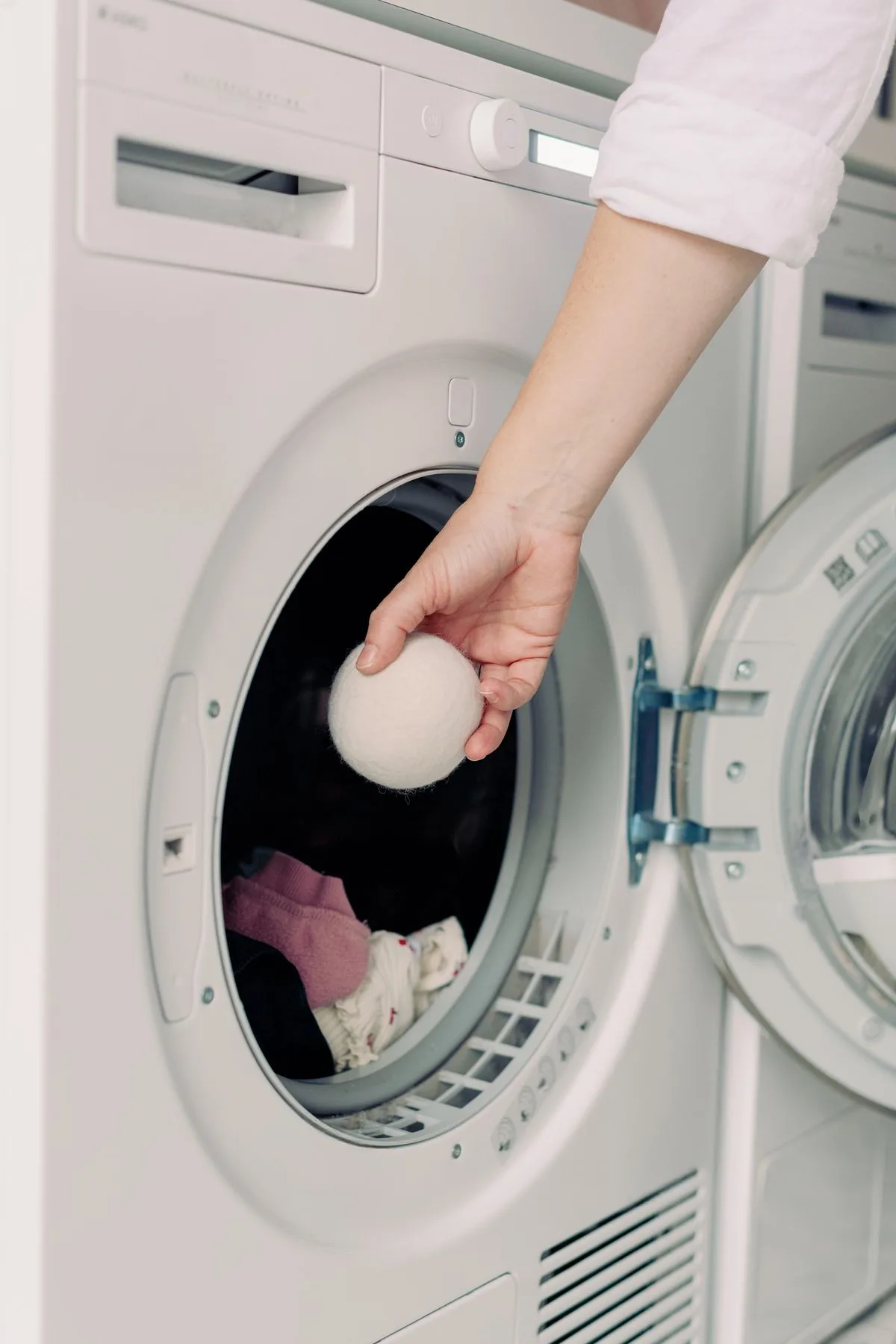
Wool dryer balls do the mechanical job in the dryer without the coating. A splash of white vinegar in the rinse handles stiffness from hard water. Both are cheap and both work.
What it adds up to
Making a garment last twice as long halves everything about it. The water, the freight, the labour conditions you were not shown, the landfill at the end. No purchase you can make does that as cleanly as keeping the clothes you already own in good condition.
That is why the four changes come ahead of anything I sell. None of them need a purchase.
If you change one thing this week, halve the detergent. It costs nothing and you will see it in a month.
About the contributor
Bree Uebergang
Bree Uebergang is the co-founder of Filthy Clean, an Australian eco cleaning brand making laundry, dishwashing and toilet sheets without the plastic jug. Her cleaning and laundry advice has appeared in The Spruce, Yahoo Lifestyle, and Homes & Gardens.