
Opinion
I Wore Only Black for Five Months. Here's What Changed.
On fashion, flowers, and the colour that makes people pause before they speak. What wearing only black for five months revealed about clothes and perception.
People assume that wearing all black is about distance. Black conjures images of veiled widows and angsty goths. It’s the colour of seriousness and emotional detachment. A lot of people mistake others who wear all black to be armoured to the teeth with severity. But that’s not always a true read.
I wear all black. Mostly for work. The fashion industry, for some reason, has an obsession with dressing in all black. From interns to creative directors, black is the uniform that binds us all together so we can recognise each other from a distance. I never really subscribed to “all black”. That is, until I did. On the weekends, I wear leopard print, distressed grey, and bright red. My black outfits are worlds apart from this, but they’re no less “me” than the leopard print jacket I wear to get coffee on a Saturday morning.
In February this year, I decided I’d had enough of wearing colour in professional settings. It started as an experiment, because I had noticed a pattern where, when wearing bright colours in more “serious” contexts, people treated me differently. Now, I pretty much exclusively wear black when I’m going into a “serious” environment. I’ve written about this before, about how fashion can shape how others perceive and understand you, and therefore treat you. But I think the idea of what you wear filters through to even smaller elements of outfits, right down to the colours we choose.
My exploration of colours actually started when I was very young. Maybe around 12 years old. I came across a digitised version of an obscure book about the language of Victorian flowers, their colours, and their meanings. It’s called *The Language of Flowers: An Alphabet of Floral Emblems, *published in 1857. It was my first experience with deep and strange interpretations about something so simple. I’d seen flowers in all the regular places, like garden beds or caught up in plastic wrap at the supermarket. It was such a foreign thing to me, to analyse how a flower’s colour could mean something secret and distinctive. The book assigned meaning to certain plants and colour combinations, in a language that could only be understood if you could decode the type of flower and its symbolism, connected with its colour meaning. The book, which is more like a dictionary, spans the whole gamut of human experience and how to communicate friendship, happiness, grief and even revenge and slander through the unassuming nature of a flower. I read the whole book, digital cover to digital cover, and it’s stayed with me well into my adulthood. I have never looked at florists the same again. Language has always been an interest for me, which makes sense given my choice of career, and this exploration of flowers and colour language was just another way for my young self to explore communication.
Looking at it through an adult lens, the Victorian interpretations of colour in that book, seem to tap into something that still runs alongside Western colour psychology. Red for love, blue for steadiness, and black for the more complicated stuff. These ideas translate directly into fashion, and into how the colours we wear influence others to construct an identity around us. You may have heard of the Green Lady of Brooklyn, a New York City woman who wears all green, or noticed that anyone who wears and owns a lot of purple things, for some reason, will tell you it’s their favourite colour. These associations with colour, rightly or wrongly, shape our interpretation of who those people are.
This is why I started to wear all black. I look young for my age - the secret is Korean skincare and it’s probably partly genetic. I noticed that the bright colours of my pre-February professional wardrobe were creating an unintentional through line, which unfortunately, can be at odds with being “taken seriously”. I decided to experiment. Would removing the colour from my wardrobe change anything? I stripped everything back, removing all colour, and took cues from Yohji Yamamoto, Ann Demeulemeester, and Rick Owens. Suddenly I didn’t feel like I was wearing a costume anymore, one that I hadn’t realised I had been putting on. I wasn’t performing a version of myself that prioritised other people’s comfort. The inner me, who’s very serious about her work, started coming forward more often. People started taking me more seriously. It’s now nearly 5 months since I made that change and I’ve learnt some important things.
Wearing all black makes people pause. They seem to think about what exactly they’re going to say before they say it, and how it might land. I think this is because black is a blank canvas. But not in the way that white is. White is inviting and crisp, like olive-branch-wielding doves. If you were a Victorian flower meanings enthusiast and gave someone a white daisy, it would mean innocence. Black is its antithesis. It’s thick, it’s layered, and it’s unpredictable. You’re never quite sure what is out there in the darkness, and so when someone is in all black, people aren’t sure exactly what it is they’re going to get. It’s a primal thing. The Victorians associated black pine with pity and blackthorn with difficulty.
Black removed all the decorative preconceptions that were working against me, allowing for more play with texture and shape, which has become one of my preferred modes of self-expression since. I started exploring the philosophy of space through clothes. Now that the colour factor was removed, it made me start thinking about how other elements like structure, shape, space, and silhouette could layer into my outfits. I mentioned Japanese designer Yohji Yamamoto earlier and his work is a great example of this. It was something that my brain latched onto the more I looked at his work for inspiration. In Japanese design philosophy, negative space is important. The gap between objects. It’s called Ma, or 間 which combines two separate symbols, one for “door” and one for “sun”, like sunlight beaming through the gap of a doorway. Yamamoto translates this to his designs through creating shapes that obscure the body’s natural form, with oversized structures that seem to sit away from the body. It comes from Zen philosophy, where empty space or the interval between objects like a person and their clothes doesn’t need to be filled. The space allows for breathing room and harmony. Incorporating this idea in what you wear is a form of controlled access, beyond colour. It changes how people read you. It invites pause. That’s how a black oversized leather men’s jacket from the 1990s became my go-to outerwear.
However there are moments where black needs interjection. I didn’t want to lean too far into goth territory or reject colours associated with femininity entirely. I’m proud to be a woman, but I still want to do connect myself to womanhood on my own terms. That’s where red comes in. My favourite work bag is a faux suede in a rich, deep red. Sometimes I opt for a flash of red nail polish, or a K-drama inspired bitten red lip, which I still haven’t quite got the hang of. I’m working on it. Black is not my personality, it’s just a preferred mode for certain purposes, like a setting on your microwave. So when my pageant coach recently asked me “if you could choose any colour that represents you, what would it be and why?” I chose red. It’s confident and a little bit energetically wilful. Those are some ways I would describe myself. If I were a plant, *The Language of Flowers *might refer to me as industrious, youthful, and loving. Beneath the black exterior, I’m red. But now I get to choose who experiences it.
About the author
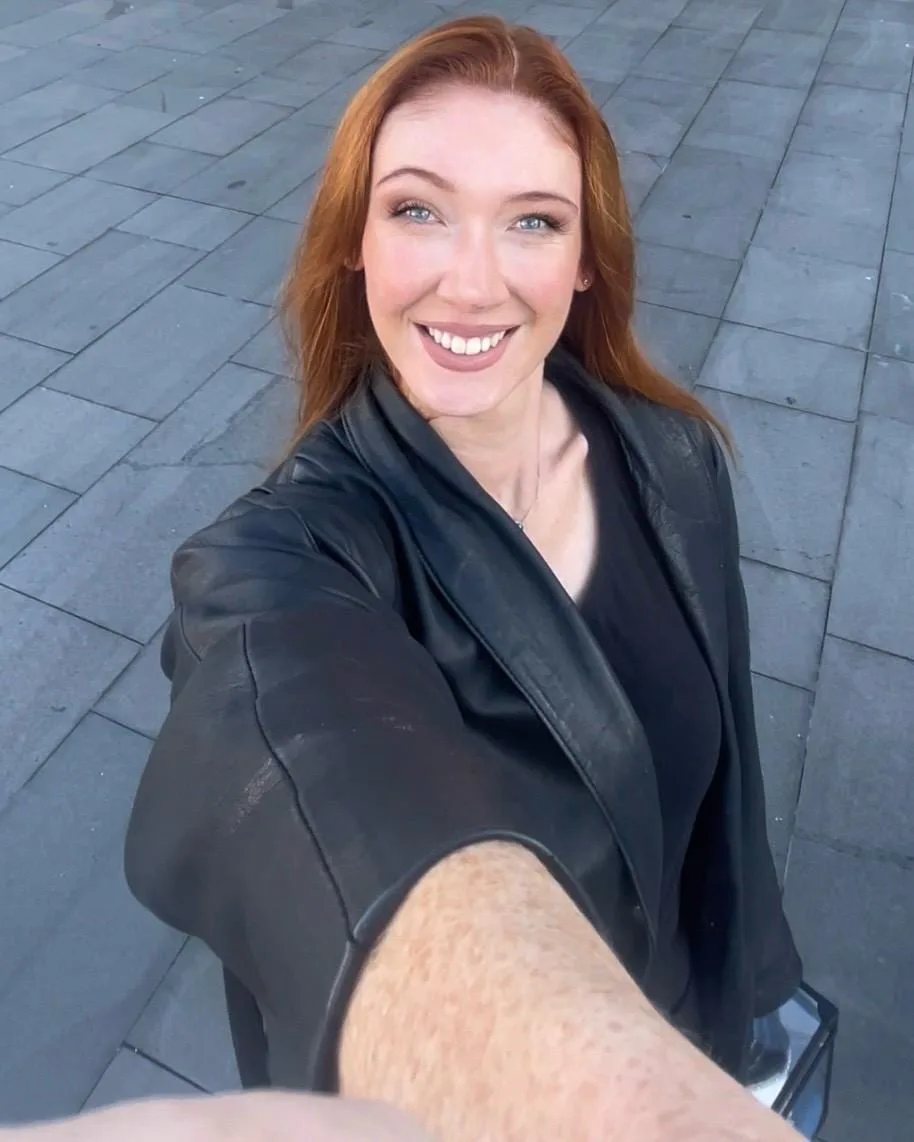
Rachel Gallagher
Rachel Gallagher is a Sydney-based fashion educator, writer, and lecturer with eight years of experience working inside the fashion industry. She founded About Your Clothes to give everyday shoppers the information they deserve, without jargon or guilt.